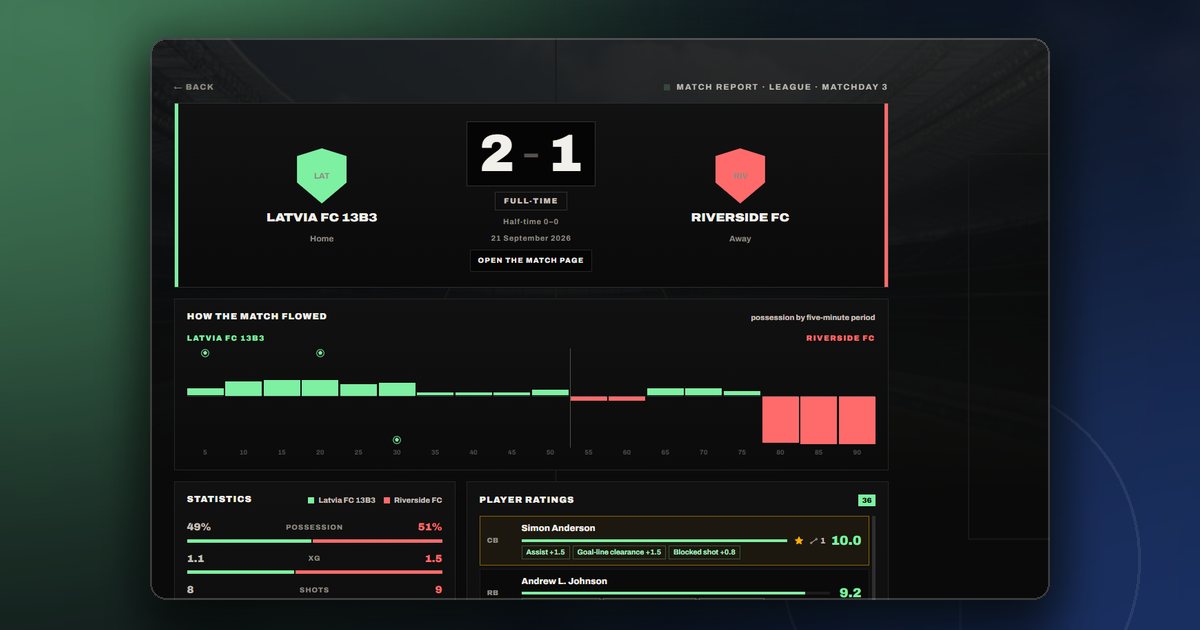
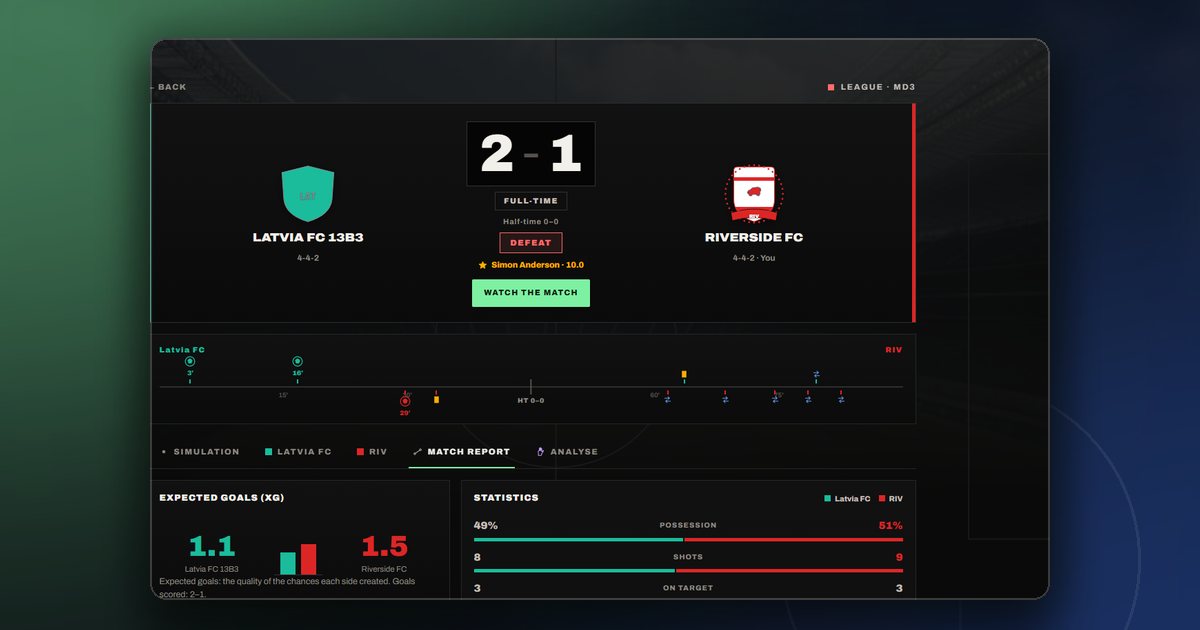
A match engine can feel right and still be wrong. Individual results look plausible; it is only across thousands of matches that the patterns show. In the first week of September 2026 we ran those thousands, compared them with what football normally looks like, and found three things to fix.
Morale that could get stuck
The first problem was morale. In long simulated careers, a team on a bad run could sink to the bottom of the morale scale and stay there, whatever happened next. We fixed how morale recovers, then checked it over five simulated seasons: morale now follows results closely — the link between recent form and morale was very strong in our measurements — and it never stayed pinned at the bottom.
We also asked a question we were slightly nervous about: does the engine favour the player's club? We ran a thousand matches with morale and condition made equal on both sides, and compared the player's club with an equivalent AI club. There was no advantage for the human side: it won as often as a comparable AI club, never more.
Goals and shots
The second problem was the numbers. Matches averaged about two goals each, a little low for the leagues we were trying to reflect — and the share of shots counted "on target" was over 90%, which is impossible in real football. That second figure turned out to be a counting mistake: misses were being recorded as shots on target.
We fixed the counting first, then adjusted goal scoring in five small, separate steps, testing a large batch of matches after each one. The final figures settled where we wanted them:
Strength that did not matter enough
The third problem was the most important. Better teams were not winning often enough. Across the range of squad strengths we tested, the win rate of the stronger side moved only from about a quarter to about two fifths — far too flat. A clearly better squad should win clearly more often.
The cause was that the engine was compressing the difference between two teams at several points, so that a big gap in quality turned into a small gap in the match. We changed how that difference is translated into possession and chances, so that real quality gaps produce real advantages, while upsets remain possible. In the multi-season tests that followed, the link between a club's squad strength and its final league position became much stronger — which is what you would expect from football.
Checking it in the real game
A calibration that only works in a test is not a calibration. After the change went live we measured 800 real matches: goals per match, shots on target, penalties and goalless draws all stayed within the targets. We then followed an evenly matched club through five more simulated seasons. It finished 11th, then 16th and relegated, then 2nd and promoted, then 8th and 10th — exactly the kind of uneven, morale-driven career football produces, rather than the same position every year.
What this means when you play
- Squad quality matters more than it did. Signing better players now shows up in your results.
- Good and bad runs feel real: morale amplifies a streak in either direction, and recovers when results turn.
- Upsets still happen. A strong side can lose to a weaker one on a bad day — just not most days.
Next in the diary: every word on screen, checked.
- 19One crest, everywhere
- 20From eight minutes to eighty-four seconds
- 21Recalibrating goals and morale
- 22Every word on screen, checked
- 23We audited our own website — and deleted what was not true
All 38 parts
- 1Why we're building ManageFC
- 2The first version — a world that ran on a clock
- 3Two-factor authentication for anything that touches money
- 4Why we deleted our battle pass
- 5Why ManageFC is English-only for now
- 6The inbox is the heart of the game
- 7Substitution plans, set-piece takers and a proper Christmas break
- 8The pivot — from one online world to a private world per save
- 9Rebuilding the game around private saves
- 10The bug that made time stand still
- 11Build your own world — 211 countries, up to 40 leagues
- 12Your money, your units — currencies and expense periods
- 13A security review in June
- 14A quieter month under the hood
- 15When registration broke — a post-mortem
- 16Players now age like players
- 17A season is 245 days
- 18Stepping into a live match
- 19One crest, everywhere
- 20From eight minutes to eighty-four seconds
- 21Recalibrating goals and morale
- 22Every word on screen, checked
- 23We audited our own website — and deleted what was not true
- 2415,000 matches to answer one question — do tactics matter?
- 25AI clubs finally choose their tactics
- 26Why you start in division 3
- 27The day the league tables froze
- 28Crises scaled to your division
- 29Half the game is played on a phone
- 30We redesigned the whole game — then rolled it back
- 31A stadium that grows with you
- 323D where it helps — the season rail and the tactics board
- 33The dressing room, and knowing when to start over
- 34Rewriting the guide and wiki with real numbers
- 35A new front door, and a blog
- 39ManageFC 3.0: why we closed the game, and what we rebuilt
- 40Your club's mailbox: everything that happens reaches you
- 41Objectives, a head coach and the end of a season
Comments
No comments yet — start the conversation.