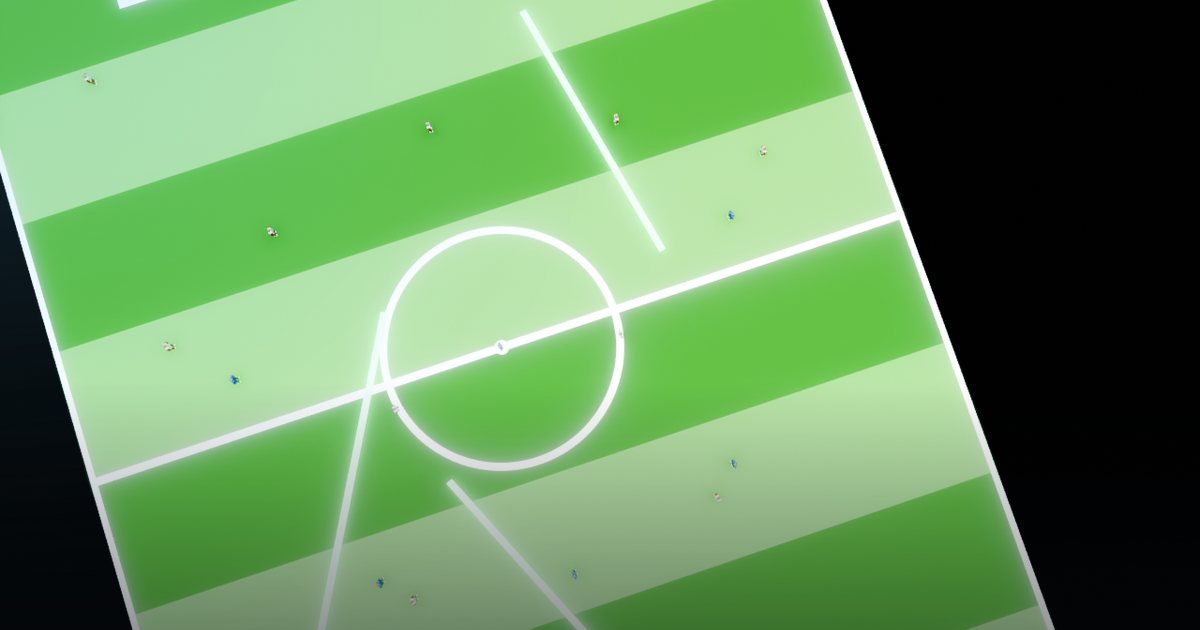
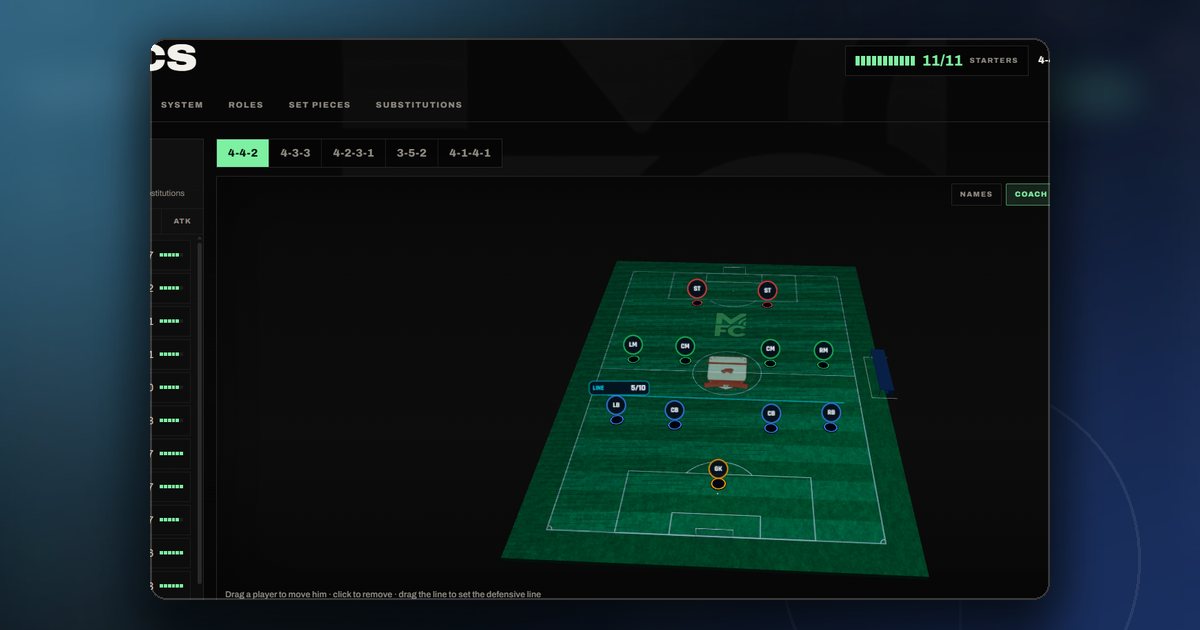
On top of formation and mentality, every ManageFC team has four tactical dials you set before each match: defensive line, pressing, tempo and width, each from 1 to 10, with 5 as the neutral middle. They are the most fiddly part of the tactics screen, and the most misunderstood. Here is exactly what they do.
The key idea: they only work in matchups
A dial is never good or bad on its own. Each one adds or removes a little strength only against certain styles or in certain formations. Moved outside those pairings, a dial changes nothing at all.
Defensive line
- Above 5: +0.6% per point against a possession side, but −0.8% per point against a counter-attacking side.
- Below 5: +0.5% per point against a counter-attacking side, −0.3% per point against a possession side.
In short: push up against teams that keep the ball, drop off against teams that break quickly.
Pressing
- Above 5: +0.5% per point against a possession side.
- But if your starting eleven averages under 60 stamina, you lose 0.4% per point instead.
Pressing is a fitness decision first. A tired or unfit squad that presses hard simply runs out of legs.
Tempo
- Above 6: +0.4% per point — but only if you play a vertical or high-pressing style.
- Below 5: +0.3% per point, only in a possession style.
Tempo should match your style. A fast tempo in a patient possession game earns nothing.
Width
- Above 5: +0.4% per point in a 4-4-2 or 3-5-2.
- Below 5: +0.3% per point in a 4-3-3.
Width follows your formation: you need wide players to use it.
The limits
All four effects are added together and then clamped: the whole package ends up between ×0.85 and ×1.20 of your team's strength. The dials can cost you up to 15% or earn you up to 20% — never more. They amplify a good team; they do not rescue a bad one.
Common mistakes
- High line, low pressing. The defence steps up while nobody pressures the ball, and every through-ball becomes a chance. Raise pressing before you raise the line.
- Maximum tempo, minimum width. Everything is funnelled through the middle at speed. Add width before tempo.
- Changing all four at once. When the next match goes badly, you will not know which change caused it. Change one dial per match and judge it over three or four fixtures.
How much should you care?
In our 15,000-match experiment, most single dial changes stayed close to the two-point noise floor of chance. That matches the numbers above: dials are fine-tuning. Get the style right first, the formation second, and then use the dials to sharpen a setup that already suits the opponent.
The full rules are in the tactical dials article.
Comments
No comments yet — start the conversation.