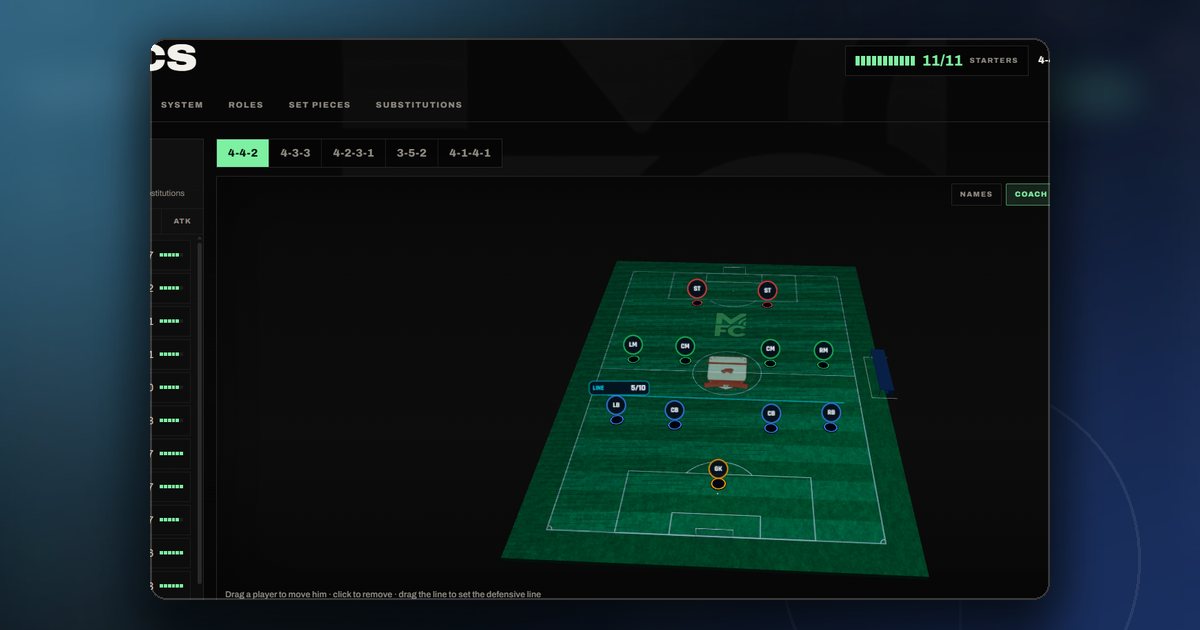
Choosing a formation is the first decision on the tactics screen, and the one managers tend to argue about most. In ManageFC the answer to "which formation is best?" is precise: none of them, on its own. A formation is always judged against the opponent's.
The five shapes
- 4-4-2 — two banks of four and two strikers. Wide midfielders hold the flanks; the front two work as a pair.
- 4-3-3 — a holding midfielder between two more advanced midfielders, with two wingers either side of a lone striker.
- 4-2-3-1 — a double pivot, a line of three behind a single striker, with a No. 10 in the middle of that line.
- 3-5-2 — three centre-backs, two wing-backs who provide all the width, three in midfield and two strikers.
- 4-1-4-1 — one screening midfielder in front of the back four, a bank of four, and one striker.
The matchup factor
Every match, the engine compares your shape with your opponent's and multiplies each team's strength by a matchup factor. Across these five formations the factor runs from 0.96 to 1.04 — up to four percent either way.
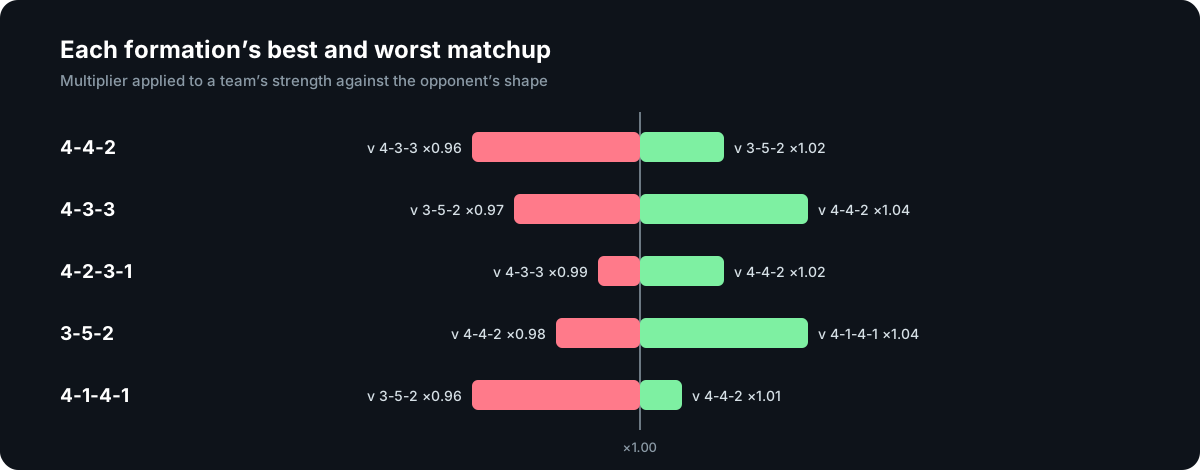
Some of the clearest pairings:
- 4-3-3 is strongest against 4-4-2 (×1.04) and weakest against 3-5-2 (×0.97).
- 3-5-2 is strongest against 4-1-4-1 (×1.04) and weakest against 4-4-2 (×0.98).
- 4-4-2 does best against 3-5-2 (×1.02) and worst against 4-3-3 (×0.96).
- 4-2-3-1 is the forgiving shape: best against 4-4-2 (×1.02), worst against 4-3-3 (×0.99) — no extremes either way.
- 4-1-4-1 beats 4-4-2 narrowly (×1.01) and suffers against 3-5-2 (×0.96), where its two banks can be outnumbered in the middle.
How big is four percent?
It is about the size of one well-chosen tactical dial, and much smaller than a bad week of morale or a tired starting eleven. It decides tight matches, not mismatches. Over a season, though, it adds up — which is why it is worth a glance at the opponent's shape before every match.
Formation and width go together
Formation also changes what the width dial does. In a 4-4-2 or 3-5-2, setting width above the middle pays, because you have wide players or wing-backs to use it. In a 4-3-3 the opposite is true: the wingers already hold the width, so a narrower setting overloads the centre. The tactical dials post covers the rest.
A practical approach
- Pick the shape your squad can staff. A formation that needs two good wing-backs is worth nothing without them — the matchup factor is small next to playing people out of position.
- Have a second shape ready for opponents your main formation struggles against.
- Check the opponent's style as well as their shape. Playing style is a much bigger lever than formation, as our 15,000-match experiment showed.
The formations article in the wiki lists every position in each shape.
Comments
No comments yet — start the conversation.