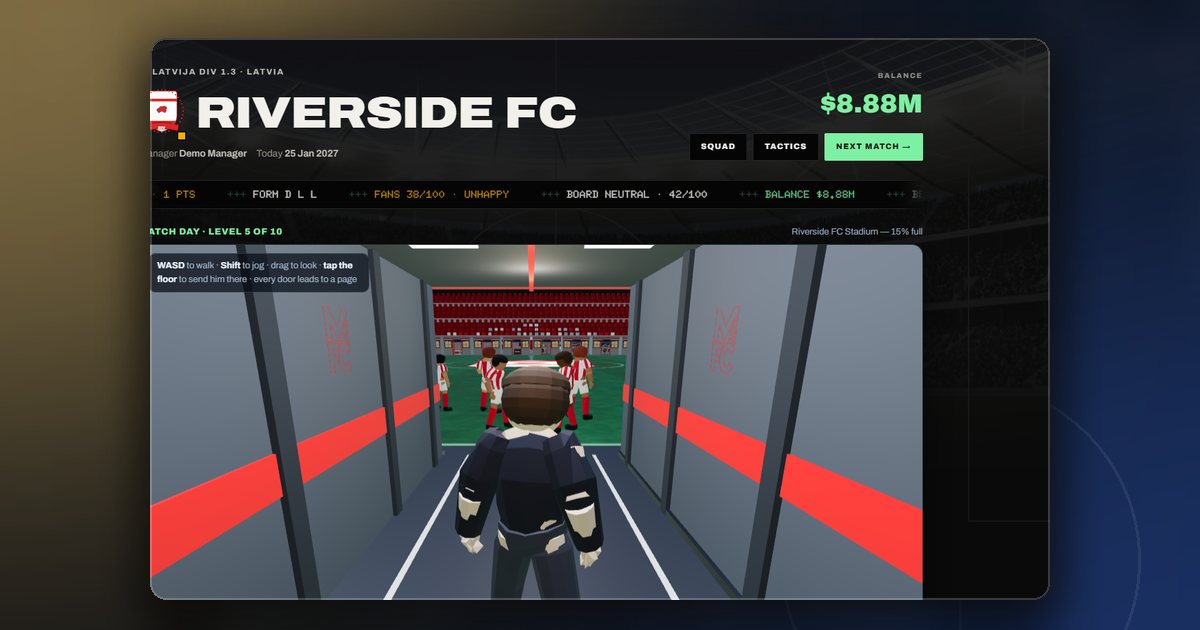
Update, 9 October 2026: new careers now start in division 10. The plan below still works for any first season, but the figures it quotes — board target, sponsor deals, wage bill — are those of division 3, which you reach after seven promotions. At the foot of the pyramid everything is smaller — the wages, the gate, the sponsors — and the club starts on a dirt pitch that it builds up level by level.
Your club has just been founded in the third division of your base country. You have a squad of 23 players, a starting balance that depends on how strong your football nation is, and a board waiting to see what you do. This guide is a practical plan for the first season, built from the numbers the game actually uses.
Day one: five things to check
- The board's objectives. In division 3 the league target is a top-half finish. The other objectives are the same for every club: win at least half your matches, keep the club financially healthy, and go deep in the cup. Read them first — they tell you what success means this season.
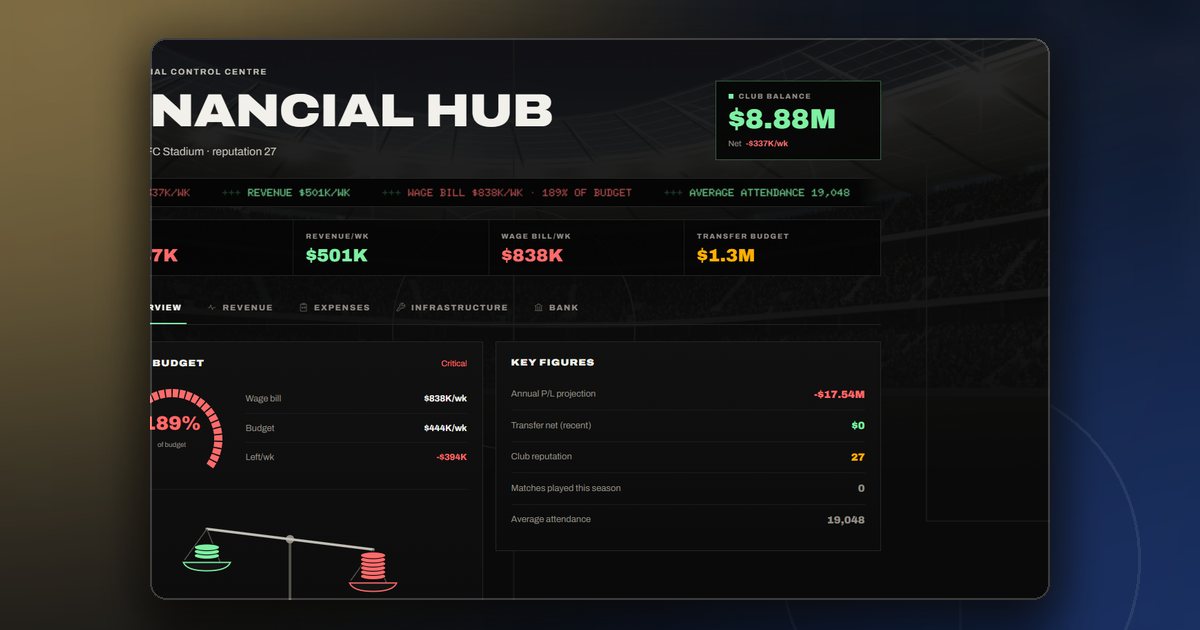
- Your finances. Open the finance page and note your balance and weekly result. A wage bill of 20,000 a week costs about 700,000 over a season, because a season is 35 weeks.
- Your sponsors. You have two slots, main and secondary. In division 3, main deals are worth roughly 15,000–18,000 a week and secondary deals 9,000–12,000, before your reputation adjusts them. An empty slot earns nothing — fill both.
- Your squad's shape. Sort by position and make sure every role in your formation has a starter and a back-up.
- Your tactics. Pick a formation your squad can actually staff, a style, and leave the four dials at 5 until you have seen a few matches.
The weekly rhythm
ManageFC moves one or three days at a time and stops on your match days. A simple weekly routine keeps you out of trouble:
- Before each match: check condition. Anyone under 75% should rest; a player at 70% plays at only 88% of his ability.
- After each match: read the ratings and the inbox. Results, injuries and board reactions all arrive together.
- Every Monday: look at the finance page. If your wage bill passes 90% of the board's budget, stop adding wages.
- Once a month: check contracts. Any player whose contract runs out at the end of the season leaves for free.
Keeping the board on side
Board confidence starts at 50 and moves only on results: +3 for a win, +5 for a win by three goals or more, nothing for a draw, −4 for a defeat, and −8 for a third defeat in a row. That last number matters most. When a run is going badly, a cautious draw is worth more to your job than a brave defeat, because it breaks the streak before the heavy penalty arrives.
Signings: patience pays
You do not need to rebuild the squad in week one. A few rules for the first season:
- Scout before you bid. A one-day look at a domestic player costs 2,500 and reveals about a third of his attributes; five days reveal everything.
- Bid close to value. Clubs generally accept around 90% of a player's market value; small increments after a rejection tend to land in the same place.
- Watch the wage, not just the fee. The fee is paid once; the wage is paid every week of every season.
- Use free agents for depth — no fee, just a contract.
Youth: a long game
The academy produces nothing until you pay for an intake. At level 1, an intake costs 100,000 and brings two prospects aged 15–17, each paid 500 a week. Read the list by potential, promote only those you will use, and give them minutes — playing time is the biggest driver of a young player's growth.
What a good first season looks like
Finishing in the top half meets the board's target. Finishing in the top five earns promotion to division 2, where weekly TV money more than triples. Either is a good first season. Avoiding the bottom five — and relegation — is the minimum.
Five mistakes to avoid
- Playing the same eleven every match until they are exhausted.
- Leaving a sponsor slot empty.
- Signing on wages the club cannot sustain for a whole season.
- Changing every tactical setting after one bad result.
- Letting good players' contracts run out.
When you are ready for more, the player guide covers every system in detail, and where the money comes from explains the economy behind every decision above.
Comments
No comments yet — start the conversation.