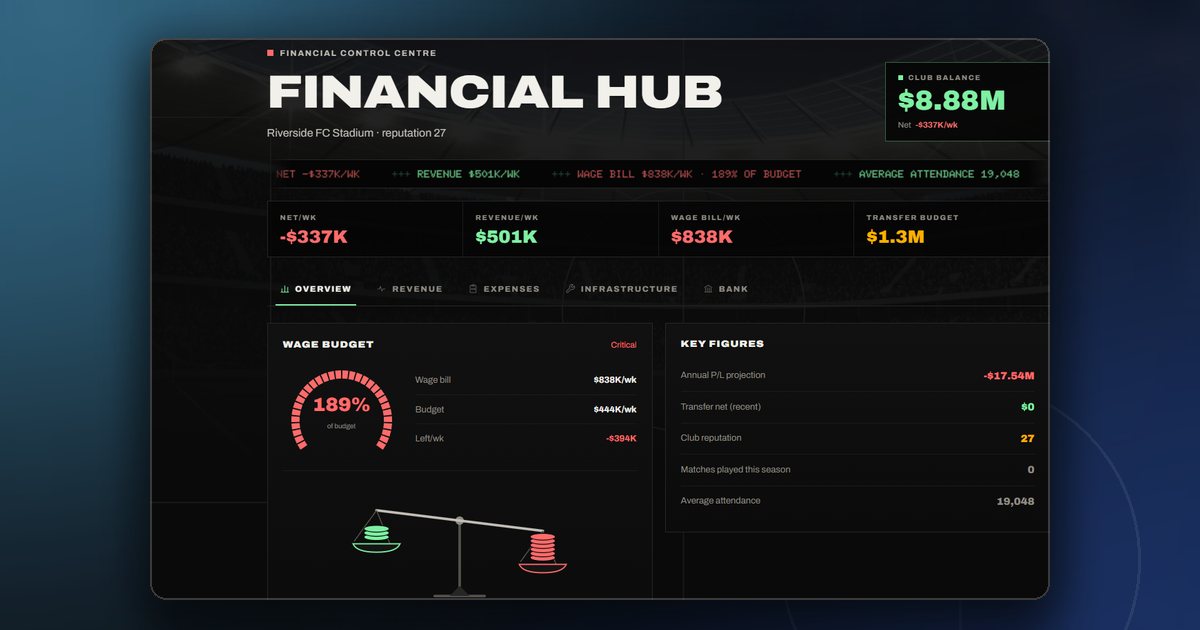
Update, 9 October 2026: for new careers every source below is now paid on the scale of the club's division — TV, commercial income, gates, sponsors and prizes are all measured against what a typical squad costs at that level. The figures in this post describe division 3 of a strong football nation.
Every decision you make about signings, wages and facilities rests on one question: how much money will actually come in? In ManageFC a club's income comes from four sources, and they behave very differently. Understanding them is the difference between a club that grows and a club that stalls.
1. TV money — weekly, and steep
Central broadcast money arrives every week in the finance pulse, not as a lump at the end of the season. It depends only on your division, and the gap between divisions is enormous:
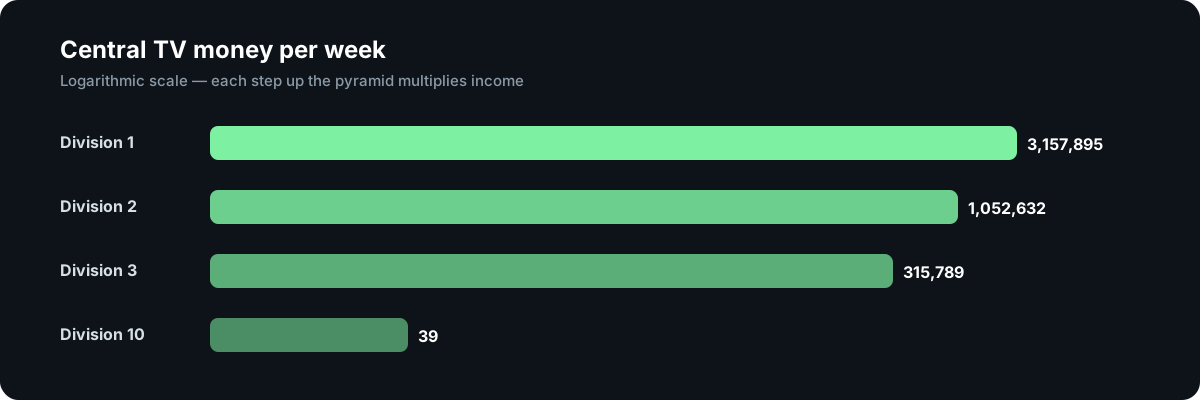
This is why promotion is the single biggest financial event for a small club. It is not a one-off bonus; it permanently raises your weekly income for as long as you stay up.
2. Prize money — only at the edges
League prize money is paid at the end of the season, and only to the top three and to relegated clubs. Division 1 pays 50 million to the champion, 25 million to second and 15 million to third. The division 3 champion receives 4 million. Fourth place in any division receives nothing — which makes the last weeks of a season worth real money at both ends of the table.
3. The gate — your stadium's job
Every home match earns ticket revenue: attendance multiplied by your ticket price. Attendance starts from your fan base, is lifted by your club's reputation, varies a little with each match, and can never exceed your stadium's capacity. Cup ties draw a smaller crowd than league matches.
Because attendance is capped by capacity, a full small stadium can outearn a half-empty large one, and ticket pricing is how you trade one against the other. The stadium pricing article explains how to move prices without emptying the stands.
4. Sponsors — steady and reputation-driven
You have two sponsor slots, main and secondary, each with one deal at a time paid weekly for the length of the contract. In division 3 the catalogue offers main sponsors around 15,000–18,000 a week and secondary ones around 9,000–12,000, before adjustments. What you actually receive is scaled by your division and by your club reputation, which can take a deal from 0.6× to 1.4× of its base value.
Two practical rules: never leave a slot empty, because an empty slot earns nothing; and think twice before cancelling a deal, because the sponsor takes it publicly and your reputation drops by five points — which lowers every future offer.
Where the money goes
Against all of that stands the wage bill, paid every week of the season whether you play or not, together with staff wages. A wage bill of 20,000 a week costs about 700,000 over a 245-day season. The board sets a wage budget; staying under it helps its confidence, and going far over it for long damages it.
Putting it together
- Promotion is the strategy. TV money alone makes each step up worth more than any single signing.
- Fill the stadium before you price it up. An empty seat earns nothing.
- Sponsors reward reputation. Results raise reputation, and reputation raises every deal.
- Wages are the long-term risk. A signing is paid for once; a wage is paid 35 times a season, every season.
The finance guide has a weekly routine, and the loans article explains when borrowing makes sense — and when it does not.

Comments
No comments yet — start the conversation.