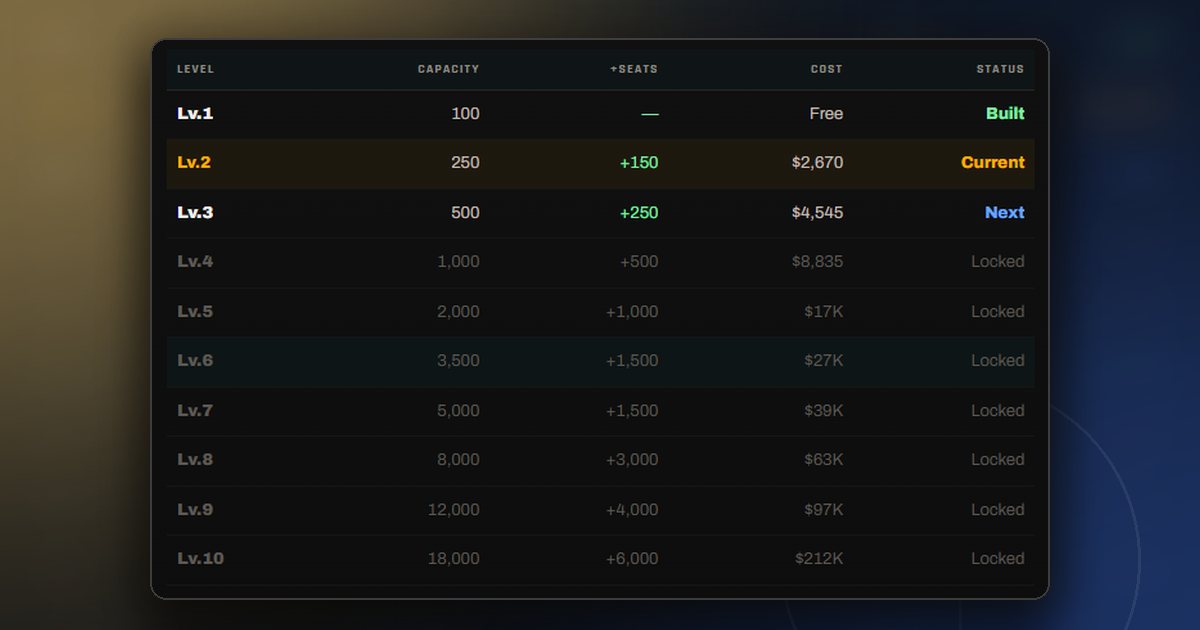
A club's ground is now something you build, one level at a time. There are twenty levels in five eras, and every new club starts on the first.
The five eras
Amateur (levels 1–4). A dirt pitch with iron goals and lines scratched into the ground, then a lined pitch with nets, a fence and a changing-room container. Neither of those holds a crowd: until the concrete steps and two floodlights of level 3 (500 people) there is nobody on the ground and no gate. Level 4 adds the first grass pitch, a small covered stand and the clubhouse bar, for 1,000.
Regional (levels 5–8). A concrete main stand with 300 seats and a ticket office for 2,000; a covered main stand and a standing terrace for 3,500; stands on three sides for 5,000; four sides, a press room and turnstiles for 8,000.
Professional (levels 9–12). Four seated stands for 12,000, hospitality boxes for 18,000, a fully covered ground for 25,000, closed corners and a scoreboard for 33,000.
Big club (levels 13–16). A second tier on the main stand for 42,000, two full tiers and giant screens for 52,000, a third tier for 63,000, three tiers all round for 75,000.
World elite (levels 17–20). A monumental roof for 90,000, the largest stadium of today at 110,000, a legendary ground for 150,000 and, at the top, the all-time record crowd of 200,000.
What it costs and how long it takes
Prices follow the division where clubs usually have each level: a level costs about fifteen weeks of the income of an ordinary club of that division, and 60% more for each earlier level that belongs to the same division. The second level costs about 3,000, the concrete steps of level 3 about 11,000, the regional main stand about 60,000, an 18,000-seat professional ground about 1.4 million, and the last levels hundreds of millions — the record-crowd stadium about 295M. The work is paid up front, in cash, and takes two game weeks for the amateur levels, four for the regional ones, eight for a professional ground, twelve for a big club's and twenty for the world elite.
Once built, a level has to be looked after: every week the club pays 0.3% of the price of everything it has built. And at the foot of the pyramid the council helps — from division 6 down, a building grant pays half of one build a season, for a level up to what clubs of the division above usually have.
What it pays back
Two things. First, room for more fans. Your supporters are not limited by the ground, but the people who can get in are: a level 3 ground lets in 500 people however many want to come. Every division has an ordinary crowd — about 60 people in division 10, 300 in division 8, 600 in division 7, 5,000 in division 4 — and a club that draws more than its division's ordinary crowd earns more on match days, provided it has the room to take them.
Second, spend per head. Every level adds 2% to what each spectator brings, and from level 4 the clubhouse bar earns on every home match as well.
At the foot of the pyramid that is small money, and it is honest about it. An ordinary division-10 crowd of about 60 people brings roughly 160 on a home match — the gate only starts at level 3, and the stand has to earn back its price and its upkeep over several seasons. It will not buy a striker, but it pays for the next step, and a larger crowd is where the next step starts.
A sensible order
Build the ground one step ahead of your crowd, not three. A stand that stays empty is money you could have spent on players, and it costs upkeep every week. Watch the fan base on the Stadium screen: when it presses against your capacity, it is time for the next level.
Comments
No comments yet — start the conversation.