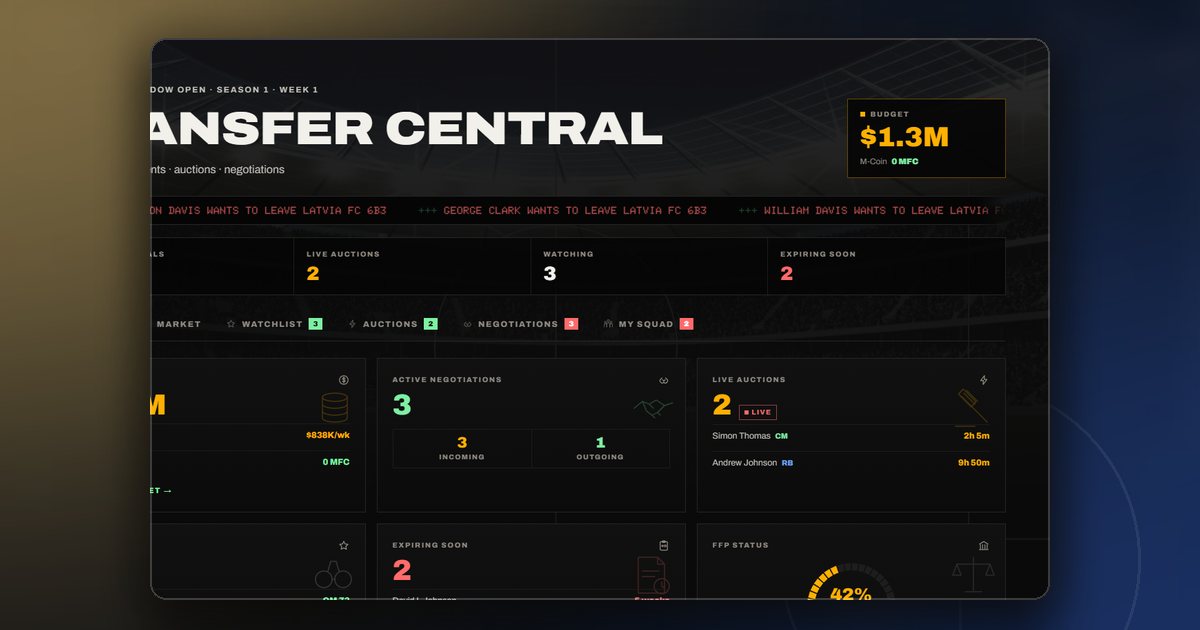
Transfers are where most managers lose their club's money. Not because they buy bad players, but because they forget that a player is not paid for once. This guide explains how the market works and how to budget for it.
How the market works
- The window is a switch. Clubs trade players in two windows a year: 1 June to 31 August and January. When the window is closed, no offer between clubs can be accepted. Check before you start negotiating — and remember that free agents can be signed at any time.
- Around 600 players are listed for sale by AI clubs in your world at any time, refreshed in weekly batches. Each listing expires after 14 days.
- You can bid for anyone, listed or not — an unlisted player's club may simply say no, or negotiate if pushed.
- Free agents cost no fee, only a contract. At an amateur club they ask for no wage at all, though a player whose level is paid football will not join one.
- Every offer lasts 48 hours. If it has not been accepted by then, it lapses and you need to send it again.
How clubs answer
A selling club compares your bid with the player's market value. At or above its threshold — roughly 90% of market value by default — it accepts. Just below, it makes a counter-offer, usually at 92–96% of market value. Well below, it rejects outright, and repeated rejected bids sour the relationship.
The threshold moves with the player's personality: a loyal player makes his club harder to buy from, an ambitious one easier. There are no add-ons, sell-on clauses or swap deals — a fee is a fee.
The real cost of a signing
The fee is the cost you see. The wage is the cost you live with. The salary you name in the proposal is what the player joins on, and it is paid every week until his contract ends on 30 June — with no bonuses to hide it behind. What a player asks for depends on his level and on the division of the club that signs him, so the same player asks more of a division-3 club than of a division-7 one.
A useful way to think about it: a player on 30,000 a week costs about 1.5 million over a year in wages. Over a three-season contract, that is often more than the transfer fee itself.
A simple budget plan
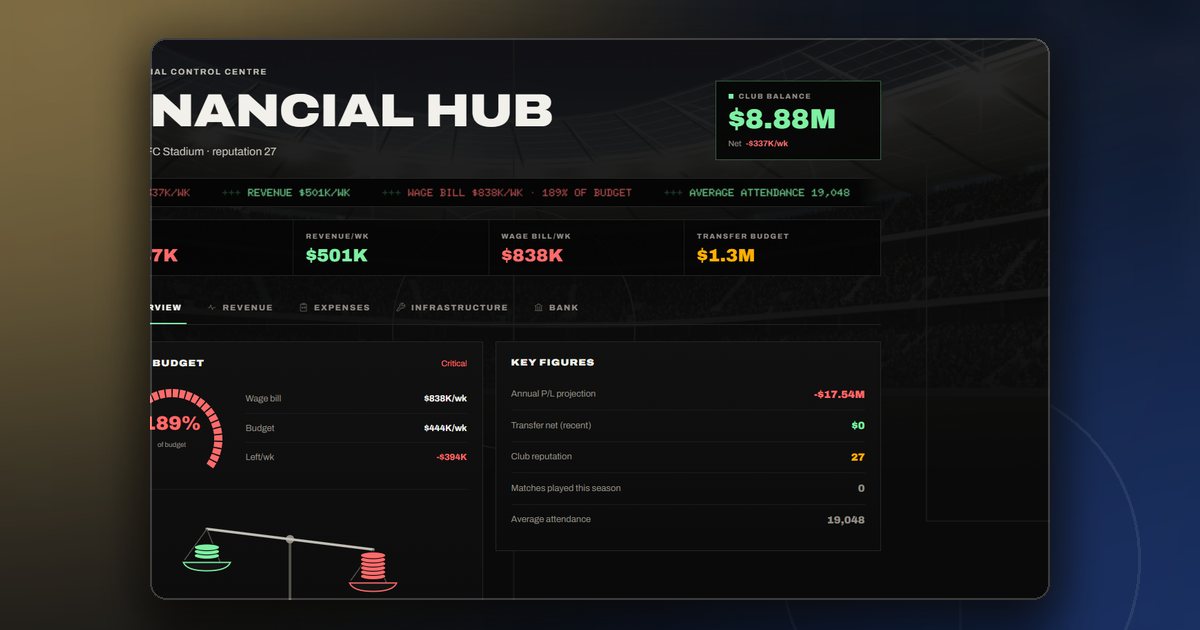
- Start from the runway. The finance page shows how many weeks your balance would last at the current rate. Before a big signing, make sure you keep at least 8 to 12 weeks of wages in reserve.
- Respect the board's limits. The board approves every wage: one player may earn at most a quarter of what the club earns in a week, and the whole wage bill may not pass what the club earns in a week. Beyond that the board simply refuses to sign off the contract.
- Sell before you buy. Transfer income is interest-free and permanent. A fringe player sold funds part of the next signing without adding to the wage bill — and the windows are short, so sell early.
- Scout first. Scouting is priced on your club's scale — a few coins a day at the foot of the pyramid, 2,500 a day in division 3 of a strong nation — plus travel if the player is abroad. Five days reveal a player's full attribute card; one day reveals about a third. Estimates of ability carry an error of up to four points either way. If you have a head scout, you can also write to them from the inbox and ask for a shortlist for a position, within a wage you set.
- Borrow only for a clear return. A bank loan is repaid over 26 weeks. Up to a fifth of what the bank would lend your club it costs 12% in total; above that, 18%. Borrowing to pay wages is almost always a mistake.
What to buy first
In your first window, the best value is usually:
- a starter in your weakest position, rather than an upgrade in your strongest;
- depth in the positions that tire fastest in your formation;
- young players with minutes ahead of them, because playing time is what makes them grow.
When to walk away
If a club counters far above your offer, you are far below their threshold. Close most of the gap in one step, or move on to another target — there are always other players in a world of hundreds of clubs.
For the full rules, see the transfer market and bidding and negotiation articles.
Comments
No comments yet — start the conversation.