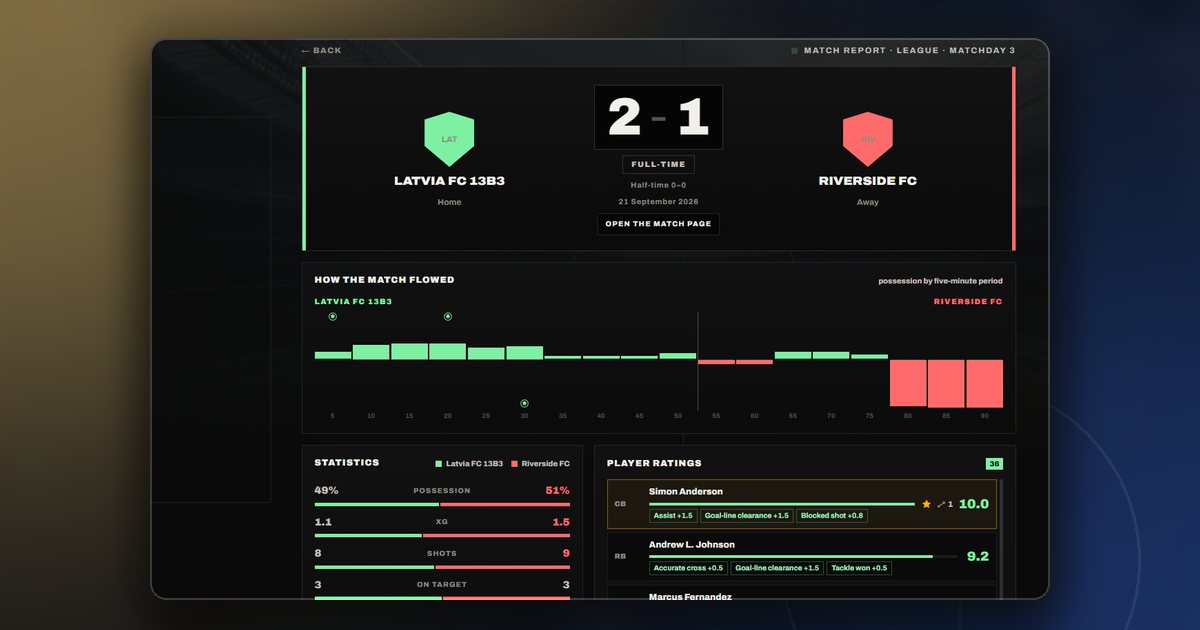
In ManageFC you will read far more match reports than you watch matches. That makes the report one of the most important screens in the game: it is where you find out not only what happened, but what to change. Here is how to read one.
The score is the least useful line
The final score tells you the result, and the result is already in your inbox. The useful information is underneath: how the match was played, and by whom.
Possession and shots
Start with possession and shots on target. Together they tell you whether the result was deserved:
- Lots of possession, few shots on target: your team controlled the ball but could not hurt the opponent. Look at your style and tempo — a patient possession game against a deep defence can produce exactly this.
- Little possession, plenty of shots on target: your team defended and broke well. If you won, the plan worked; if you lost, it was probably the finishing or the goalkeeper on the day.
- Both low: you were outplayed. Check condition and morale before you change tactics — tired or unhappy players lose duels everywhere.
The timeline of events
The report lists the match minute by minute: goals, assists, cards, injuries, substitutions. Two patterns are worth looking for:
- Late goals conceded. Fatigue climbs throughout a match and bites hardest on physical attributes. If you keep conceding in the last fifteen minutes, your substitution plan should replace tired players earlier.
- Injuries to the same players. Players in poor condition are more likely to get injured. Repeated injuries are usually a rotation problem, not bad luck.
Player ratings
Every player starts the match on 6.0. His rating moves with his ability relative to the rest of the players on the pitch, with his consistency, and with what happened:
- defenders and goalkeepers gain for a clean sheet;
- midfielders gain when the team dominates possession and lose when it is dominated;
- everyone on the winning side gains a little and everyone on the losing side drops a little;
- playing fewer than 75 minutes costs a little, fewer than 30 a little more.
Because ability is part of the starting point, a rating is a comparison: a modest player rated 7.2 in a strong match was genuinely excellent; a star rated 6.4 was quiet.
Turning a report into decisions
After each report, ask three questions:
- Who is below 6.5 for the third match running? He may need a rest, a talk, or replacing.
- When did the goals come? Late goals point to fitness and substitutions; early goals to the starting setup.
- Did the style suit the opponent? If you had the ball but no chances against a team that defends deep, try a more direct style next time against a similar side.
Change one thing at a time. A single match is a small sample — our tactics experiment found that chance alone moves results by a couple of percentage points — so judge changes over three or four fixtures.
The match day guide explains the whole routine around a fixture, and how a match is simulated explains where every number in the report comes from.
Comments
No comments yet — start the conversation.