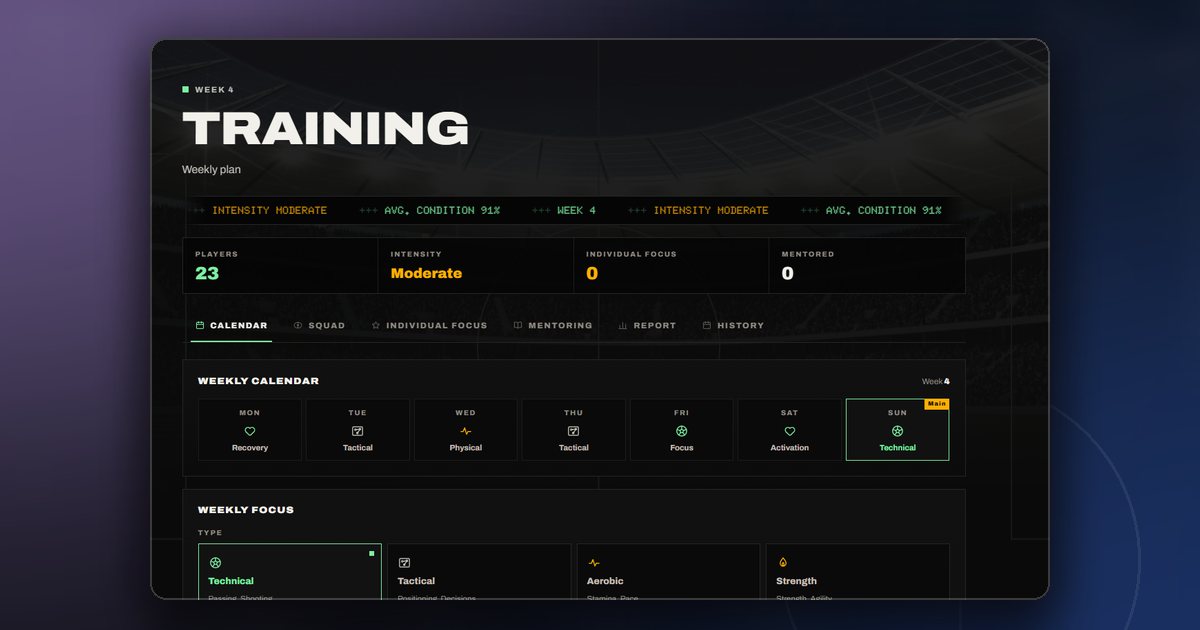
The hardest part of rebuilding ManageFC's economy was not the top of the pyramid. It was the bottom. For a long time every player in the game, however modest, earned at least a hundred a week, so a squad of amateurs cost more than an amateur club could ever earn. The fix started with a simple question: what do real footballers at that level actually get paid?
What real pyramids pay
We looked at three football countries with deep pyramids.
In England, the professional game ends at the fifth level, the National League, where a typical player earns somewhere around £900 a week and many are full-time. One and two steps below, the pay drops to a few hundred a week for the better players. By the time you reach steps five and six of the non-league system, players are paid expenses — travel, and perhaps £40 to £80 a match — and many get nothing at all.
In Germany, the fourth-level Regionalliga pays around €1,000 a month on average; the Oberliga below it a few hundred; and from the Landesliga down most players receive an expense allowance rather than a wage.
In Portugal, below the professional leagues the pay turns into allowances, often below the minimum wage, and in district football it is famously paid in sandwiches.
The pattern is the same everywhere: almost nothing at the bottom, a slow rise through the semi-professional levels, and then a steep climb from about the fifth and fourth levels upwards.
What that means in the game
ManageFC now follows that pattern division by division. Divisions 9 and 10 are amateur: nobody is paid. Divisions 7 and 8 pay expenses, divisions 5 and 6 are semi-professional, and divisions 1 to 4 are fully professional. In a strong football nation an ordinary player earns somewhere between 21 and 85 a week in division 8, between 130 and 520 in division 6, between 1,250 and 5,000 in division 4 and between 25,000 and 250,000 in division 1. A whole squad of 22 costs nothing in divisions 9 and 10, about 1,000 a week in division 8, about 2,000 in division 7, about 21,500 in division 5 and about 120,000 in division 3. Weaker football nations pay less at every level, as they do in reality.
The same rule holds for every club, the ones the game runs for itself included. And it cuts both ways: a player whose level is paid football will not join an amateur club, however much the club would like him. When a club goes up, every contract rises to at least the new division's minimum wage — the first real bill of the climb.
Staff follow the same logic. A coach's wage is a share of what the club earns, growing with his ability, so at the foot of the pyramid it comes to a few coins a week in expenses. Amateur clubs do what amateur clubs do — they run on volunteers until they can afford a professional.
Why it matters
Because promotion should change your life. When the money at the bottom is honest, every step up feels like one: a bigger crowd, the first paid players, a paid coach, the first proper stand. That climb from nothing is the game we wanted to make.
Comments
No comments yet — start the conversation.