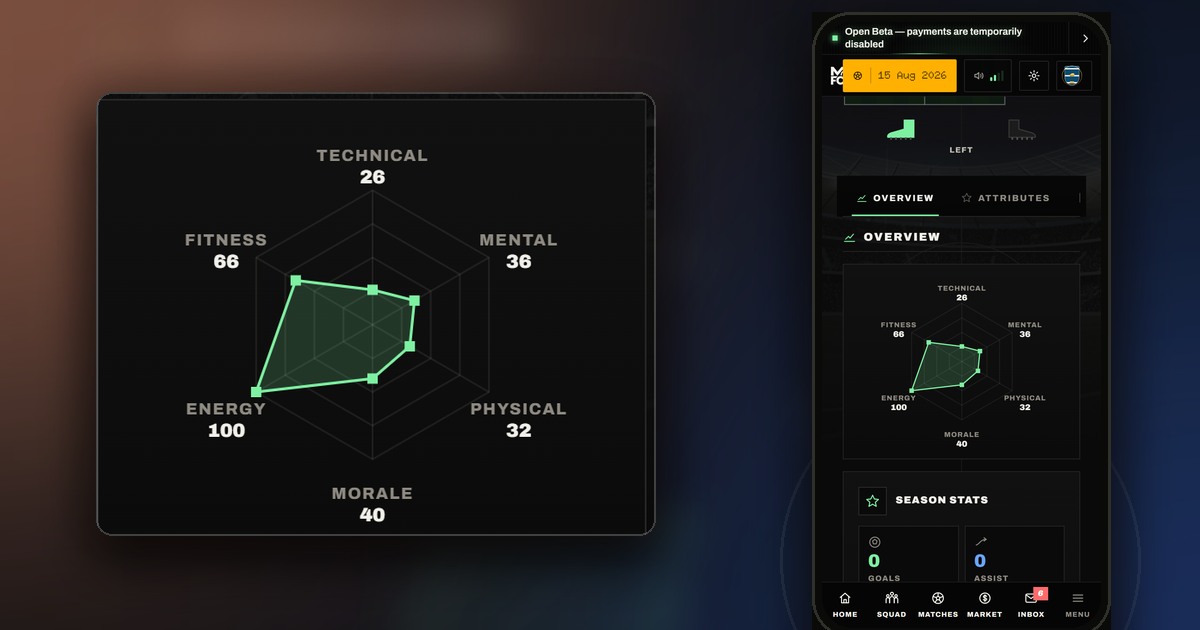
For a long time one bar did two jobs. It had to tell you how fresh a player was for the next match and how much the season had taken out of him. Those are different questions, and one number could not answer both. So this month we gave each question its own number.
Energy: what he has for this match
Energy is the short number. It runs from 0 to 100; 80 is the line where we count a player as fit, and most players sit above it when the week is calm. It is the value the match uses when it works out how well a player runs, presses, tackles and lasts. When you pick a team, energy is the number to look at first: a player at 100 is ready, a player in the 60s will give you less than his attributes promise.
You will see it in the squad list, on the tactics bench, on the player profile and in the live match. In the live match it is the number we put in front, because it is the one that changes what you are watching.
Fitness: what he has left in the season
Fitness is the long number. It is built from a player's stamina and age: high in young, durable players, lower in a career that has been going for fifteen years. It answers "how much has the season taken out of him?", not "can he play on Saturday?".
That makes it the second question a manager asks. Two players can have the same attributes and the same energy on Friday and still be in very different shape for the months ahead. Fitness is how you see that difference before it costs you a match.
Two bars, two places
On every page where a player appears, the two values now have their own bars and their own names. Energy is the bright one; fitness is the thin steel bar underneath it. The old word for all of this, condition, is gone from the game — it was the word that made one number try to be two.
What it changes for a manager
Rotation stops being a guess. You can see, at a glance, who is tired for Saturday and who is carrying a long season. A young squad with high fitness can absorb a busy month; an older squad needs the opposite: fewer minutes, more recovery, and a plan for the weeks when the fixtures do not stop.
The first step was to give each number its own name, its own bar and its own place on every screen. The next step is the part you will feel over a full career: making fitness respond to minutes, age and training across seasons, so the wear of a long campaign is visible in the squad you built. That work is under way.
Two numbers, two jobs. The next time you pick a team, you can see both.
Comments
No comments yet — start the conversation.