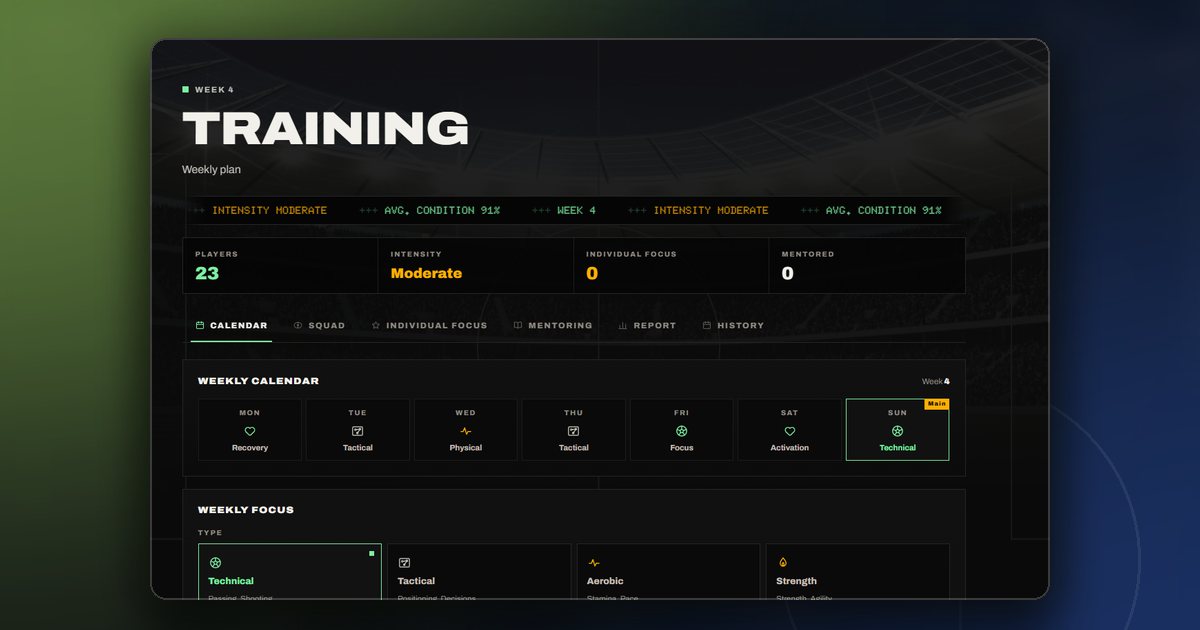
We built training to be the simplest screen in the game: pick a session, pick an intensity, walk away. Then we watched how the system actually behaves over a season, and realised the screen that grows your players isn't the training screen at all — it's the one where you pick the eleven. Here's how it really works, and a routine that gets results out of it.
One pulse, once a week
Everything developmental settles together on the weekly pulse — the same one that pays the wages. Training, growth rolls and mentoring all resolve in one batch. So what you set on the Training screen is a plan for the whole week ahead, not a daily instruction.
We give you two choices: a session category (there are twelve) and a squad intensity — light, moderate or intense. Some categories deliberately don't offer an intense version, and if you ask for more than a category supports, the engine quietly pulls your session back to moderate. Every session carries a condition cost of roughly 4 to 14 depending on the intensity — unless it's one of the two recovery categories, which pay condition back instead (+5 active, +10 passive).
What actually grows a player
Every week, a player who is 30 or under and below his hidden potential gets a growth roll. The size of that roll comes from three things:
- Age. The base is strongest under 19, then steps down at 22, 25 and 28.
- Personality — determination, professionalism, ambition.
- Minutes. This is the lever that belongs to you. A player who played 90 minutes last match gets a 1.15 multiplier; 45 or more gets 1.05; anything less (or nothing) gets 0.85. Under-21s who pass 45 minutes get an extra tenth on top.
That last point is the whole trick — and it's the part of the system we're happiest with. An under-21 starter rolls at 1.25× versus 0.85× for the same player sitting on the bench: a third of his growth, spent on an identical training programme. A prospect who trains perfectly and never plays develops slower than one who plays every week.
Training adds its own multipliers on top: the coaching staff in that category's area (up to 1.25×), your club's development reputation (0.9× to 1.1×), and any mini-game bonus. Useful — but smaller than minutes.
A week that works
This is the routine we would run ourselves:
- Play your prospects. Over 45 minutes is the target; under-21s should reach it whenever the fixture allows.
- Match the intensity to the age. Under-21s: intense where the category allows, but rotate them so condition recovers between matches. Ages 23–30: moderate is the value play. Over-30s: no growth path is left — low intensity and careful minutes slow the weekly decline roll instead.
- Use the recovery sessions deliberately. After a heavy week, the two recovery categories aren't laziness — they're how you get the squad back to the top of the condition bands.
- Mind the condition cost. A tired player on an intense programme loses his growth to the fatigue he's carrying. Check the Squad screen before the week's session goes in; anyone under 75% should be resting, not grinding.
- Read your inbox. We write to you when a player improves a skill, and we warn you when tiredness is building — it's the report card for the plan you set.
One more thing worth knowing: from 31 onward the same weekly pulse runs the other way, with a rising chance that a physical attribute drops. Age isn't something a session plan fixes — see Ageing and retirement.
Where to read more
The full model, down to the roll thresholds, is in the wiki (Player development); the condition maths behind the rotation advice is in Condition & fatigue. For the academy side, start with the youth article and get the screen-level walkthrough from the development guide.
Comments
No comments yet — start the conversation.