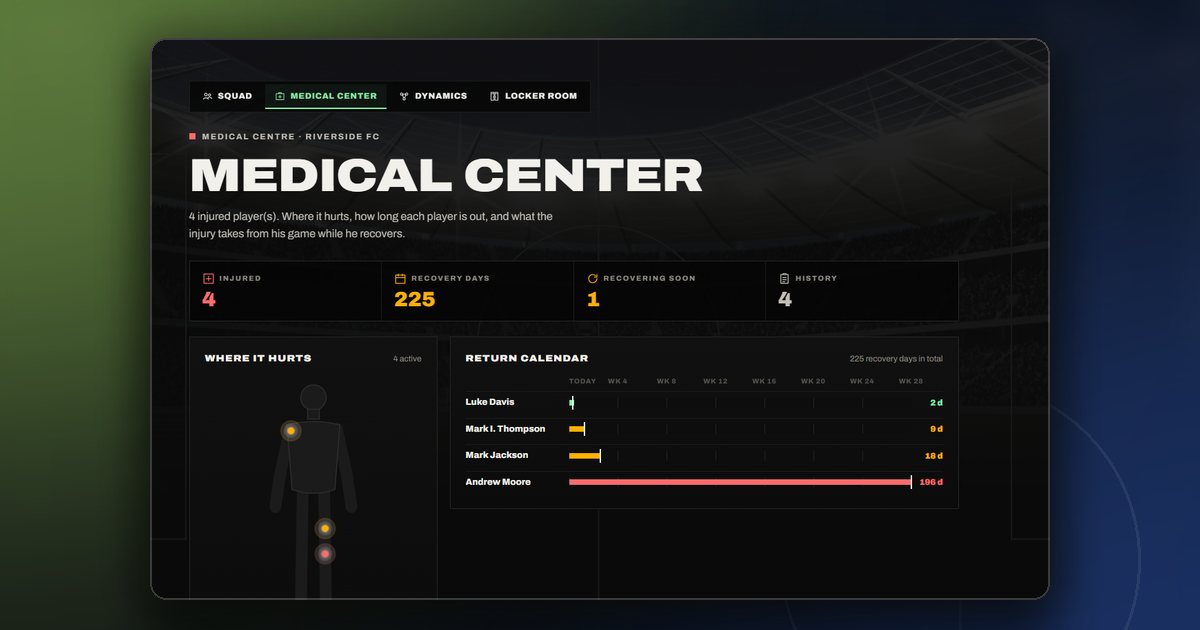
Every manager loses players to injuries. Here's the part almost nobody realises: most of the injury table is authored on the squad screens, not by the injury roll itself. We know, because we wrote the roll — and it's more forgiving than the table it gets blamed for. Here's how it works, and the two dials that are actually yours.
The roll, in one paragraph
After every match, each player takes one injury roll per match. The chance starts tiny and is built up from a short list of ingredients: how injury-prone the player is (a hidden trait across a wide range), how tired his legs were when he played, how physical the match was, and his age — from 28 onward the risk climbs about 2% per year. A physio on your staff trims up to a quarter off the final number (a new club starts without one), and no player's chance in a single match ever exceeds a hard cap. We made it deliberately rare per match. It is not rare per season — eighteen players times thirty matchdays is a lot of rolls.
The dial that matters most: condition
A player's condition multiplies the risk. Fresh legs carry the baseline; the middle band multiplies it by around 1.15; the band below that by around 1.4; and a player running on empty multiplies the whole thing by 1.8. Nothing else on the list is as movable as this. You can't change a player's proneness or his birthday, but you decide whether he plays a third match in three weeks at 60% condition.
A practical target: start nobody under 75% condition unless it's genuinely the biggest match of the season. Use the substitution plan's tired trigger to pull players off around the 65% mark rather than letting them ride it to the whistle — the last twenty minutes are exactly where empty legs meet late tackles.
The second dial: minutes and recovery
Condition recovers daily — a fit player rebuilds roughly three points a day — but a match costs several times that. Once a player is hurt, every level of your medical centre makes the injury heal 4% faster. How to keep heads above water:
- Rotate by fixture, not by feeling. A run of league Saturdays with a cup tie in the middle is a squad run. Decide who sits before the tiredness arrives, not after.
- Use the rest option in training after heavy matches — it gives back half of what the squad is missing, which can be worth more than any single session.
- Count the injured you already have. A thin squad forces tired players onto the pitch, which produces more injuries. Break that loop in the transfer market, not in the treatment room.
- Check the age column. Your 30-somethings carry the extra percentage, so give them the extra day of rest.
What nothing you do can change
Proneness is hidden and fixed, and the roll is a roll — sometimes a fully fit squad simply loses a player for a week in a match you controlled. That's football, and no amount of care removes it. The management part is everything around the randomness: if your club is losing more players than the division average over a season, the fix is on the rotation sheet, not the pitch. The condition article has the full maths, and Ageing and retirement covers the extra percentage that age quietly adds to every roll.
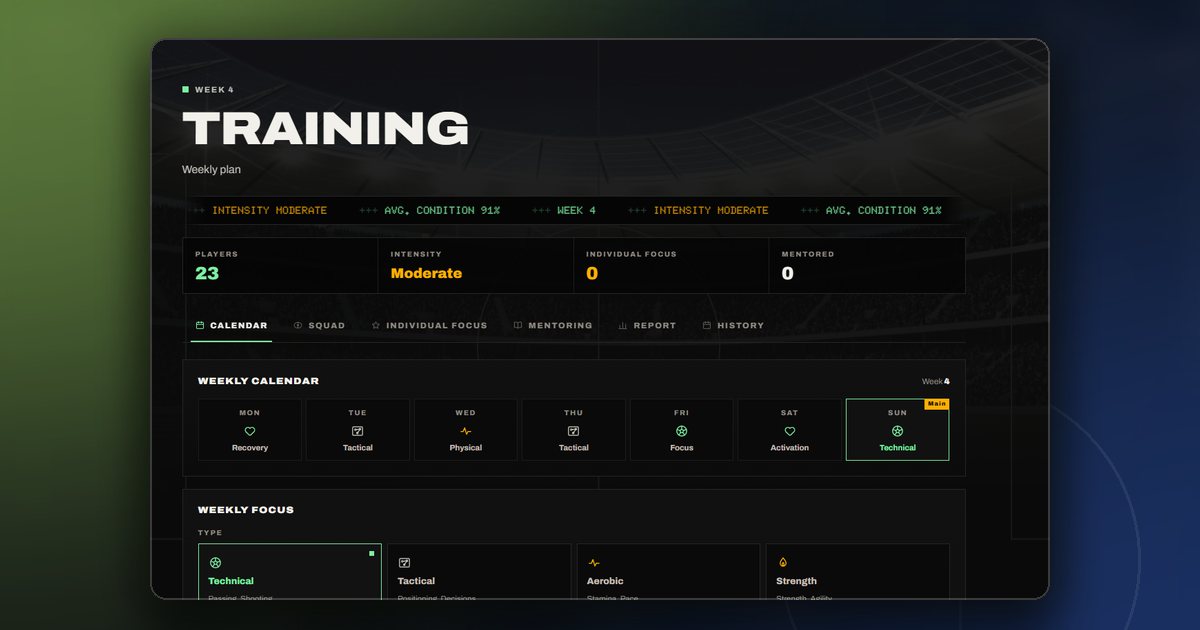
Start with the plan for your training week — the rest week and the intensity schedule are the cheapest injury insurance in the game. The squad screen's condition column (see the squad guide) is where you catch the 78% starter before the match, not the 62% one.
Comments
No comments yet — start the conversation.