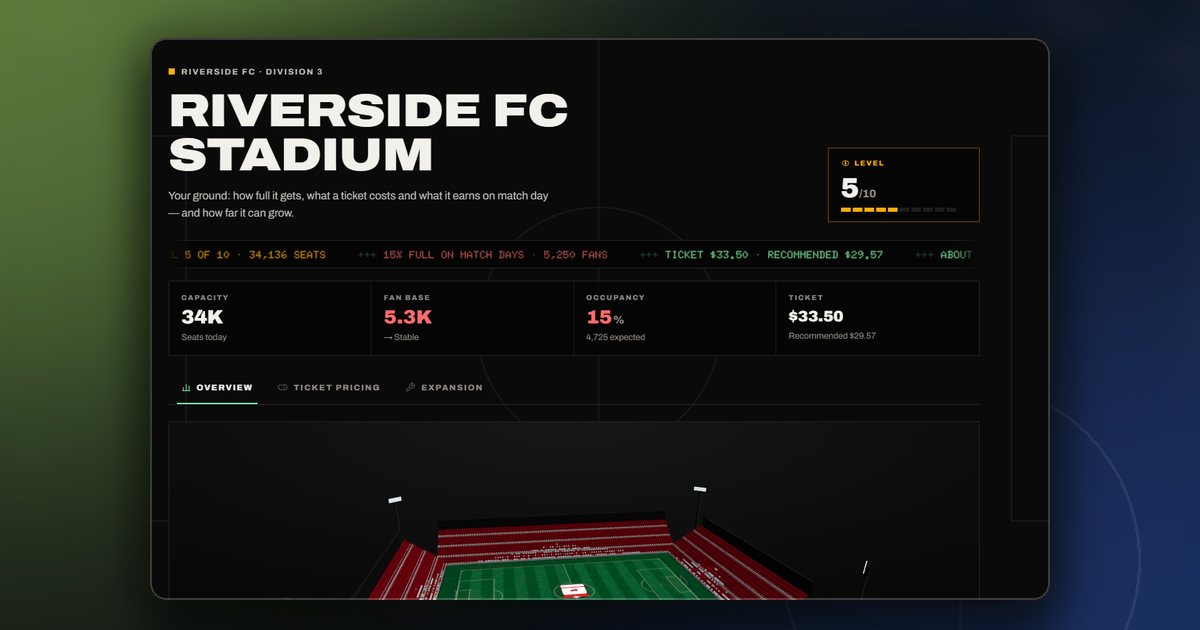
Ticket pricing in ManageFC is one slider from 1 to 100, one price for the whole ground, and it's the most feel-it-in-the-pocket decision on the stadium screen. The good news: nobody expects you to invent the price. We give you a recommendation, and the recommended band is where the whole story lives.
How the recommendation is built
The suggested price starts from your division's market — the engine knows what a division 2 crowd expects to pay and what a division 9 crowd will tolerate — and then shifts by your club's reputation (see what reputation buys): every 50 points of reputation moves the recommendation by about 10%. A famous club can charge a little more than its division suggests; an unknown one a little less.
Around that recommendation sit four bands, at roughly 60%, 85%, 120% and 150% of the recommended price. Your price falls into one of them, and the label — from bargain end to gouging end — isn't just a caption. It's the dial that decides how your crowd evolves over the coming weeks.
What the bands actually do
- Priced at or under the recommendation's lower bands, your fanbase grows — slowly, a couple of percent a week, more when the deal is very cheap. You're investing gate money in future bums-on-seats.
- Priced above the upper bands, your fanbase shrinks at the same kind of rate. You're harvesting the present, and the future invoice arrives quietly.
Two hard rules shape everything around that dial:
- A cheap ticket never grows your fan base past 85% of capacity — treat that as your true sell-out, even when the price is a give-away. And until you have built a stand (stadium level 3), the ground holds nobody, so there is no gate to price at all.
- If the fan base ever falls under 15% of capacity with the price untouched for three weeks, the board writes. That's the one pricing line the club enforces — and pricing is the one lever where "generous" is a real cost, unlike the fans' mood, which doesn't read prices at all.
A routine that works
- Start at the recommendation. It's the market's honest answer, and it's where most successful clubs live.
- Pick a direction, not a wiggle. If you're building the fanbase for the climb, sit in the growth bands for a stretch of weeks. If you're funding a signing and the ground is full anyway, harvest the top band briefly — then come back down.
- Watch the gate, not the price. A price rise that still fills the ground at 85% is free money. A "sensible" price with a half-empty stand is losing twice: lower gate income now, slower fanbase growth later.
- Remember the cups. Cup nights read differently — cup tickets are cheaper, a cup gate is worth about 60% of a league gate per head, and each club takes 45% of it, with the home club paying the stewards — so don't over-read one small cup crowd as a fanbase collapse.
- Re-check after promotion. The recommendation moves with your division the moment you go up — from the first home match, last season's clever price can be the new season's leave-money-on-the-table.
The mathematics — bands, growth rates, the attendance formula — lives in the wiki's stadium and pricing article, and gate income itself is broken down in Match revenue. The finance guide shows how a good gate day lands on the weekly pulse.
Comments
No comments yet — start the conversation.