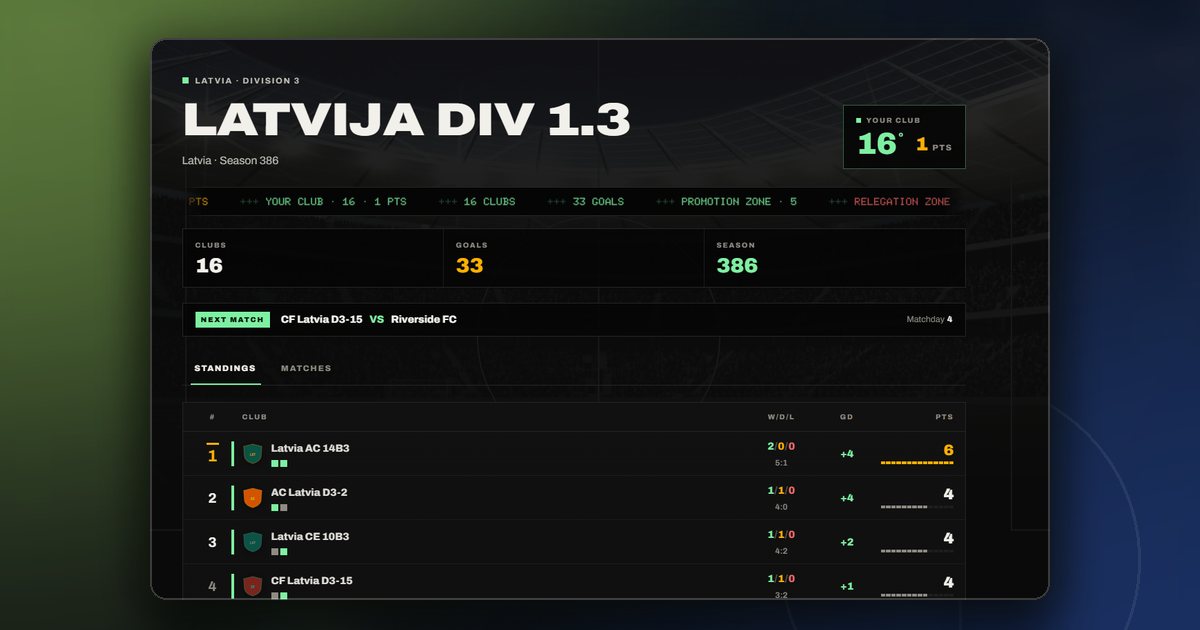
Every country in ManageFC runs a pyramid of divisions — division 1 at the top, division 10 at the bottom of the ladder — and everything your club does ultimately serves the crawl upward. We kept the movement rules simple, completely transparent, and a little unforgiving. Learn them once and the end of every season becomes a readable story instead of a surprise.
Who goes up, who goes down
- The bottom five clubs in a division are relegated.
- The top five clubs in the division below are promoted in their place.
- Every league has sixteen clubs, so five up and five down means nearly a third of each table changes every year.
That's the whole system. There are no playoffs and no promotion finals. Where you finish after the last matchday is where you finish.
Settling ties
If two clubs finish level, the engine looks down a fixed list, in order:
- Points — obviously.
- Goal difference.
- Goals scored — because in a tie, the side that scored more is the more persuasive case.
- Club name, alphabetically, as the final and frankly ruthless tie-break. Yes, really. Lose nothing by name.
Alphabetical order is worth a breath here: if your season comes down to a tie you can't control, it was already lost weeks earlier — the tie-break is just the messenger.
The rhythm of a season
The calendar is fixed and uniform: 30 matchdays, every one of them on a Saturday at 15:00 local time, starting on the second Saturday of August. Between them sit eight rounds of the national cup and three free Saturdays for international breaks, so the last league match falls in early May and the cup final in mid-May. The season itself runs from 1 June to 31 May, with the summer transfer window open from the first day, so the drama and the admin run in lockstep all year.
The real prize is the income step
Promotion matters far more than the medal, and that's by design. Moving up a division rewrites your club's income permanently: the league's own money rises with every division — in a strong football nation a division 3 club banks around 34,000 a week from the league's distribution, against 750,000 in division 1, and below division 6 there is none at all — and the prize ladder follows the same scale (explained here). The champion of division 3 collects about 1.1 million, and every club in the top five earns two more weeks of its income for going up; the champion of division 10 collects about 1,200. The gap between those two numbers is the game's difficulty curve.
The squad quality curve points the same way — the higher division's clubs are visibly better, division by division, which is why the last promotion step always feels like arriving somewhere.
Planning with the ladder in view
Two habits pay immediately: treat the top five and bottom five as the only lines that matter when you read the table mid-season, and treat promotion as what it actually is — a permanent change to your club's budget, not a one-off prize. Wages, sponsor expectations and the board's objectives all re-scale the day you go up — every contract in the squad rises to at least the new division's minimum wage.
The structure is in the wiki's league article, and the season's week-by-week rhythm in the season cycle. If you're new to the ladder, start at the bottom of it: every career begins in division 10.
Comments
No comments yet — start the conversation.