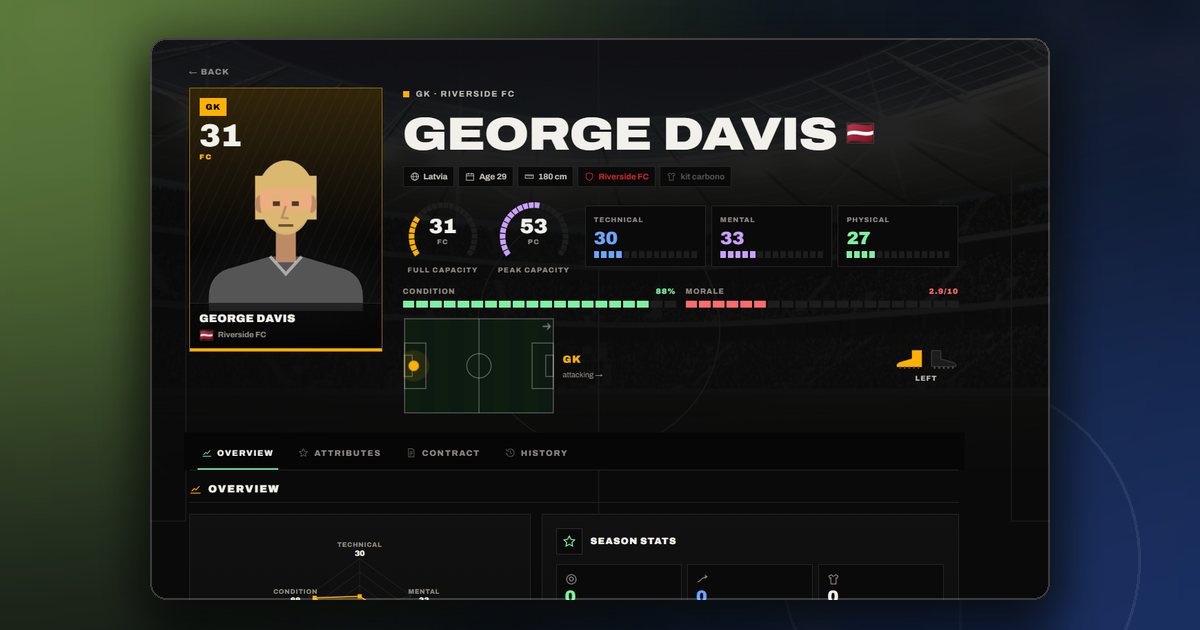
We age ManageFC's players honestly, and honest ageing is a strange compliment: your 33-year-old is worse than he was at 28, and there's no training programme that fixes it. But only part of him is fading. The trick to a veteran is knowing exactly which part.
What declines, and how fast
From 31 onward, the legs go a little every month. A player loses on average a point and a half of his physical attributes a month at 31–32, three at 33–34 and five from 35 — not a cliff, a staircase you can hear coming. Natural fitness and professionalism soften it by up to a quarter, which is why two players of the same age age differently.
Here's the part most managers miss, and it's the design decision we're proudest of here: only the physical attributes decline. Technique, passing, vision, composure, decisions, leadership — untouched. A 35-year-old loses his sprint and his stamina; he doesn't lose the mind that made him worth signing in the first place. Players turn a year older once a season, when the season ends — and that is also when the veterans decide whether to carry on.
Roles that stop paying for legs
Rebuild the veteran's game around what remains:
- Central, not the flank. Centre-backs, holding midfielders, deep playmakers — positions where the first three yards matter less than the next three passes.
- The last 30 minutes, not the first 60. A 34-year-old as a planned substitute is a real weapon: fresh legs against tired ones, with the game-reading of a man who has seen everything.
- Set pieces. The penalty taker's nerve and the free-kick taker's right foot don't age. See the captain and the four takers — an old specialist is still a specialist.
- The armband. Leadership 15 or higher turns your veteran into a permanent +0.6 morale drip for the whole squad, from a place in the XI where his legs hurt least.
- The mentor's seat. This is the big one — see below.
Mentoring: the veteran's second career
Every club can pair a mentor with a young player. The requirements: the mentor needs real quality (an ability of 75 or more — on today's scale a star of the top divisions), and the mentee has to be 25 or younger. When the pairing clicks, the weekly pulse banks extra progress for the youngster — up to half a point of ability a week — until he gains three full points or gets within five of his ceiling. The veteran can also warm up to a point of morale when the job is done.
A mentor who plays 90 minutes every week is winning you matches. A mentor who plays 90 minutes every week while a 19-year-old trains beside him is winning you a decade.
Letting go, correctly
Retirement is decided at the end of every season, for every club alike. From 33 the chance grows each year — roughly one in five at 33, one in three at 34, one in two at 35, and more in the lower divisions — and at 38 it is certain. When one of your players retires, your inbox tells you. Until then the exit is your call: sell a season early while the fee is real, or keep him to the end as a bench mentor and eat the wages. Both are legitimate — the mistake is the middle path, keeping an ageing starter on starter's money and expecting the staircase not to arrive.
The mechanics live in the wiki: Ageing and retirement and Player development. The morale maths behind the armband is in Morale — causes, effects and recovery, and the other side of this coin is the academy — start with the youth article.
Comments
No comments yet — start the conversation.