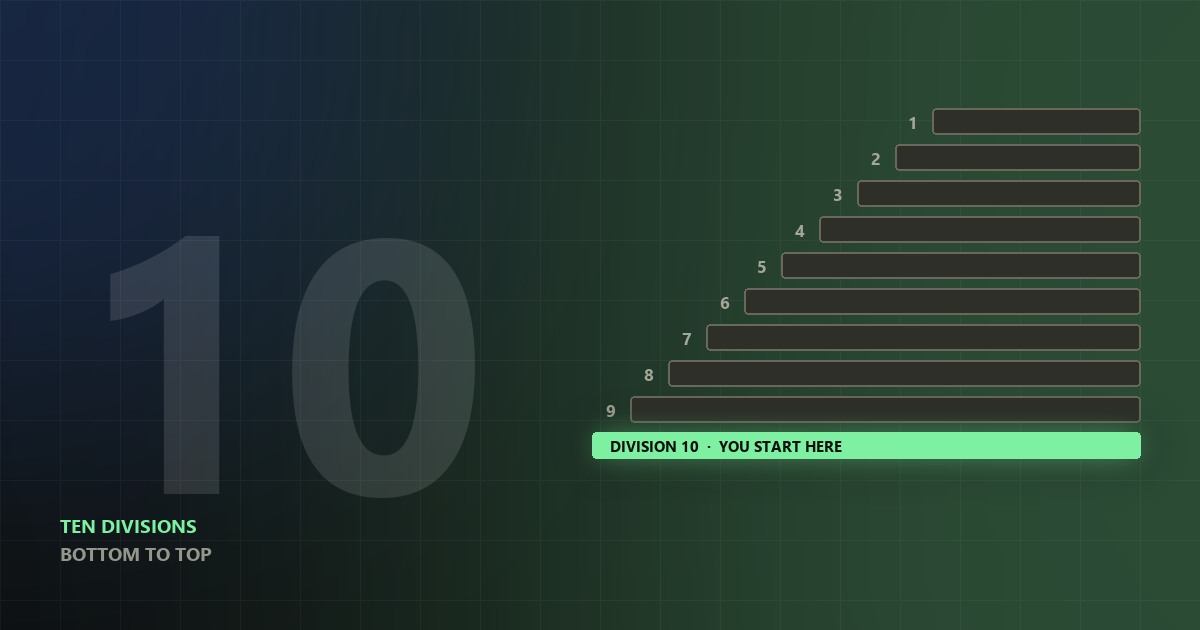
The message was short and clear: "I can't even get out of division 10." It was not the first time we had heard it, and when we looked properly, the bottom of the pyramid had two problems. Neither was about tactics.
The teams around you were too good
Every division is supposed to have its own level. A division-10 side should play like a division-10 side: fewer good decisions, less sharp in front of goal, more likely to crack under pressure. In the new rules that adjustment had been switched off. The result was that every AI team, from the first division to the tenth, played at full strength. At the top nobody noticed. At the bottom it felt like a wall.
The adjustment is back, and it is a ramp rather than a switch: the lower the division, the more the teams around you play like teams of that division. The top is untouched. Division 1 is still the hardest place in the game, and it should be.
The free agents you could sign were never on the list
The second problem was quieter. The free-agent page sorted every player by ability and showed the best hundred. For a small club, that meant a list of players far above its level, all marked as wanting paid football, and none of them willing to join. The players who would actually sign — the ones lower down the list — never made the cut.
The page now starts from what your club can realistically offer. An amateur club sees amateur players, with "unpaid" where that is the truth, and a player whose level is paid football no longer fills the screen with a refusal.
We played it ourselves
We did not want to judge this from a spreadsheet. We took a career at the bottom and played the matches in the browser, the same way you do.
Before the change, the league record was one win, five draws and one defeat in seven matches, and the cup match ended in a defeat. After it, the next four league matches were four wins: 4–1, 3–1, 2–0 and 3–0. One career is not a laboratory, and the opponents were not the same in both runs. But it was the same game you play, and the difference was the one we wanted to feel.
The climb is still the game
None of this makes promotion automatic. You still have to build a squad, pick a plan and survive the weeks when the fixtures pile up. What changed is that the bottom of the pyramid now behaves like the bottom of a pyramid: a place where a new club can find its feet, win a few matches, and start the climb.
The top of the game has not moved. When you get there, it will not be gentle.
Comments
No comments yet — start the conversation.