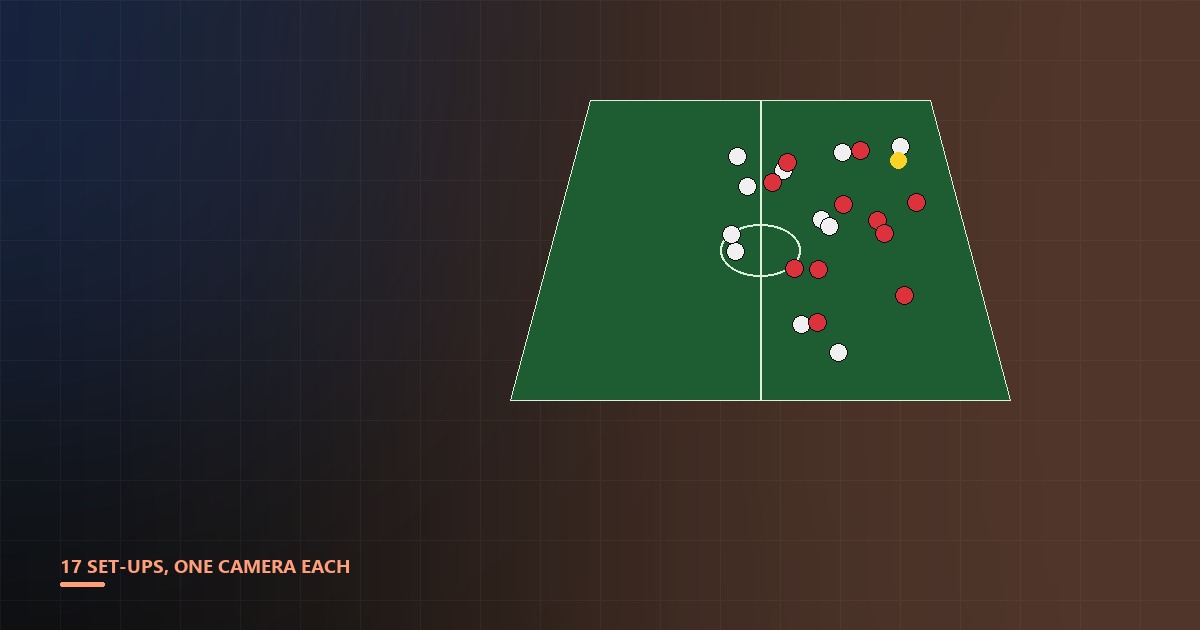
The live match has had a 3D stadium for some time. What it did not have was a match inside it. The ground was there, the crowd was there, and the events were told in text beside an empty pitch.
Everybody on the pitch
The 3D pitch now carries all twenty-two players, the referee and his two assistants, in kits that never clash. For each moment of the match they take the positions that moment calls for. There are seventeen of them, studied from how real teams set up:
- the kick-off, open play, an attack, a cross;
- a shot — saved, off the post, or cleared off the line;
- a ball won back;
- a corner, with most players crowded into the box;
- a direct free kick, with the wall at 9.15 metres;
- a wide free kick and an ordinary foul;
- a card, with the referee's arm in the air;
- a penalty, a goal kick, a throw-in;
- an offside, with the assistant's flag up;
- a goal celebration, an injury, a substitution.
It is a snapshot, not an animation: the players are placed, the ball is placed, and the scene reads at a glance. The player at the centre of the moment carries his name and his quality above his head.
A television camera
Each moment also has its own camera, the way a broadcast is directed: a cut for every set piece, framed on where it is taken, and a camera that follows the ball in open play. On a phone the camera uses its own lens, so the action fills a tall screen instead of a strip.
A show for every moment
Outside the 3D view, the big moments now have their own scene, built around the player card you know from the squad list: cards, penalties, free kicks, corners, the post, the great save, the clearance off the line, the chance that went begging, offside, injuries and substitutions. A goal stamps the card of the scorer — with his goals of the season, which, we should add, now count correctly: a scorer could finish a match with his season tally still showing zero.


Comments
No comments yet — start the conversation.